If you’ve served our country, you’ve earned some pretty valuable benefits. And one of those may be the opportunity to purchase a home using a VA home loan.
But just because you’ve earned the benefit doesn’t mean somebody handed you an instruction manual explaining how to use it!
I get questions about VA loans all the time. Do you really need zero down? What about your credit score? Why does everyone make such a big deal about VA appraisals? And what happens if you’ve already used your VA loan benefit?
Let’s tackle some of those questions!
If you’re new to VA financing, you can also visit my VA Home Loan Resource Center for an overview of the program, its benefits, qualification requirements, and the homebuying process.
VA Loan Down Payments, Closing Costs & Funding Fees
Do VA loans really require no down payment?
For many eligible borrowers, yes!
One of the biggest advantages of VA financing is the opportunity to purchase a home with zero down payment.
But that doesn’t automatically mean you won’t need any money to buy the house.
There may still be closing costs, prepaid expenses, inspections, and other costs associated with purchasing a home.
And in certain situations, such as having reduced available entitlement or purchasing a home above its appraised value, a down payment or additional funds may be necessary.
What is the VA funding fee?
The VA funding fee is a one-time fee that helps support the VA home loan program.
The amount depends on several factors, including whether you’ve used your VA loan benefit before, the type of loan, and whether you’re making a down payment.
For many borrowers, the funding fee can be financed into the mortgage rather than paid out of pocket at closing.
But here’s something important: Not everyone has to pay it!
Certain borrowers are exempt, including qualifying veterans receiving or eligible to receive VA disability compensation, certain surviving spouses receiving Dependency and Indemnity Compensation, and eligible active-duty Purple Heart recipients.
You can find current funding-fee percentages and exemption information on the VA’s official funding fee page.
Can the seller pay my closing costs?
Yes! And this is an area where there’s a lot of confusion.
You may have heard that sellers can only contribute 4% toward a VA buyer’s closing costs.
That’s not quite how it works.
The VA has a 4% limit on certain seller concessions, but ordinary seller-paid closing costs and certain discount points aren’t counted toward that limit in the same way.
Depending on your transaction, we may be able to negotiate seller contributions that help reduce the amount of money you need at closing.
The important thing is knowing which expenses are allowed and structuring the contract correctly.
That’s something I work through with you and your real estate agent before we get too far down the road!
Can I combine a VA loan with down payment assistance?
Potentially!
Although many VA buyers don’t need a down payment, assistance programs may help eligible borrowers with certain closing costs or other permitted expenses.
Availability depends on the assistance program, your qualifications, the property, and whether the program can be combined with your particular VA financing.
Don’t assume you can’t use assistance simply because you’re getting a VA loan. Let’s check your options.
VA Appraisals, Inspections & Property Requirements
Are VA appraisals harder than conventional appraisals?
This is one of my favorite VA loan myths to clear up!
VA appraisals do have specific requirements, but that doesn’t mean every VA appraisal is going to turn into a nightmare.
Like other mortgage appraisals, a VA appraisal helps determine the property’s value.
VA appraisers also consider Minimum Property Requirements (MPRs), which address basic safety, soundness, and sanitation.
The goal isn’t to make buying a home impossible. It’s to make sure the property meets the requirements for the loan.
And remember, a VA appraisal is not the same thing as a professional home inspection. I recommend that buyers consider a separate inspection, regardless of the loan program.
Does Oklahoma require a termite inspection for VA loans?
The VA requires wood-destroying insect (WDI) inspections for applicable properties in certain geographical regions, and Oklahoma is one of the states on that list.
While Oklahoma doesn’t require termite inspections for many other mortgage loan programs, VA loans have their own federal property requirements.
But getting a termite inspection doesn’t necessarily mean there’s a termite problem!
It simply means the property needs to be evaluated for wood-destroying insects and related conditions.
If an inspection identifies an issue, we’ll review what needs to be addressed and whether treatment or repairs are required.
Here’s a helpful tip: If you’re buying a home in Oklahoma, let’s talk about these requirements early so nobody is surprised right before closing.
What if the home needs repairs?
It depends on the repairs.
Some issues are cosmetic and may not prevent VA financing. Others can affect whether the property meets VA Minimum Property Requirements.
When required repairs are identified, there may be options to negotiate with the seller, complete work before closing, or use an approved repair escrow in limited circumstances.
Not every repair situation qualifies for an escrow or exception.
My advice? If you’re looking at a house with obvious condition concerns, talk to me before you make an offer. It’s much easier to plan ahead than scramble when we’re supposed to be getting ready for closing!
Can I buy a manufactured home or a home with acreage using a VA loan?
Probably, yes!
VA financing isn’t limited to traditional houses in subdivisions.
Certain manufactured homes, condominiums, multi-unit properties, and homes with acreage may qualify, provided the property and transaction meet applicable VA and lender requirements.
For manufactured homes, factors such as permanent foundation, property classification, and other eligibility requirements can make a difference.
For rural properties, we may also need to review access, utilities, land use, outbuildings, and comparable sales.
Living in northeastern Oklahoma, I know how important these conversations can be!
So if you’ve found a property that’s a little different from the typical house down the street, send me the details before ruling it out.
VA Credit, Income & Qualification
What credit score do I need for a VA loan?
Here’s something that surprises a lot of people.
The Department of Veterans Affairs does not establish a universal minimum credit score for VA-backed loans.
Individual lenders, however, may have their own credit requirements, sometimes called lender overlays.
But our investors, dear friend, have NO overlays here.
Even so, your credit score is only one part of the picture. Payment history, outstanding debts, income, and other financial factors can also affect your qualification.
If you’re concerned about your credit, don’t automatically assume you can’t qualify.
Let’s review where you stand and determine your next steps.
You can also read my Credit 101 for Homebuyers article for more information about how mortgage lenders evaluate credit.
What is residual income, and why does VA care about it?
Residual income is one of the features that makes VA underwriting a little different from some other loan programs.
In simple terms, it’s the qualifying income you have remaining after certain monthly debts, housing expenses, taxes, and other required deductions.
The VA uses residual income guidelines based on factors such as household size, region, and loan amount.
Why?
Because qualifying for a mortgage isn’t just about whether you can make the house payment. It’s also about having enough money left over for everyday living expenses.
And I think we can all agree that having a house is a lot more enjoyable when you can still afford groceries!
Can I use military housing allowances or VA disability income to qualify?
Often, yes!
Eligible military allowances, including Basic Allowance for Housing (BAH), may be considered qualifying income when properly documented and when applicable requirements are met.
VA disability compensation may also be used as qualifying income.
Depending on the income type and applicable underwriting guidelines, certain nontaxable income may receive special consideration in the qualification process.
Every situation is different, so we’ll review your actual income and documentation rather than guessing based on an online calculator.
VA Entitlement, Loan Amounts & Reusing Benefits
Is there a maximum VA loan amount?
This is another question where the answer depends on your individual situation.
If you have full VA entitlement, the VA does not impose a county loan limit on the amount you can borrow.
But that doesn’t mean unlimited borrowing!
You still have to qualify based on your income, credit, debts, assets, and the property itself. The lender also has to approve the requested loan amount.
If you have reduced or remaining entitlement because of another VA loan or an earlier claim, applicable county conforming loan limits may affect your zero-down-payment options.
Rather than assuming a particular maximum loan amount, let’s review your entitlement and purchasing goals.
Can I use my VA home loan benefit more than once?
Absolutely!
Your VA home loan benefit isn’t necessarily a one-time opportunity.
Depending on your circumstances, you may be able to restore your entitlement after paying off a previous VA loan and disposing of the property.
There are also situations where you may be able to restore entitlement after paying off a loan while retaining the property, subject to VA’s rules.
And in some cases, borrowers can have more than one VA loan at the same time if they have sufficient remaining entitlement and meet applicable requirements.
The important thing is understanding how much entitlement is available and what it means for your next purchase.
If you’ve used your VA benefit before, don’t assume you’re finished with it!
Can I Turn My Current VA Home Into a Rental and Use My VA Benefit to Buy Another Home?
Potentially, yes! And this is an option a lot of veterans don’t realize they may have.
Let’s say you purchased your current home using a VA loan. You’ve lived there, built some equity, and now you’re ready to move into another home.
But instead of selling the first property, you’d love to keep it as a rental.
Here’s one strategy we can explore:
You may be able to refinance your existing VA mortgage into a conventional investment-property loan, paying off the original VA loan while keeping the home.
Once that VA loan has been paid in full, you may qualify for a one-time restoration of your VA entitlement, even though you still own the property.
That restored entitlement could then help you purchase your next primary residence using VA financing.
So now, instead of selling your first home to purchase your next one, you may have an opportunity to keep the original property as an investment while using your VA benefits for your new home!
A few important things to understand:
- The one-time restoration while retaining the property is exactly that—one time.
- Refinancing doesn’t automatically restore your entitlement. We must request and obtain restoration through the VA.
- You’ll need to qualify for the conventional refinance, including any investment-property requirements, and for the new VA purchase loan.
- Your next VA-financed home must meet VA primary-residence occupancy requirements.
- You’ll want to compare interest rates, closing costs, equity requirements, expected rental income, and the overall financial impact before deciding whether the strategy makes sense.
And here’s something else worth knowing: Depending on how much VA entitlement you have remaining, refinancing the first home might not even be necessary to qualify for another VA purchase.
The important thing is having a plan before making changes to your current mortgage. This is why STRATEGY matters!
If you’re thinking about keeping your current home as a rental while purchasing another, let’s look at your entitlement, equity, and financing options together. There may be more possibilities than you realize!
For more information about restoring entitlement, visit the VA’s official home loan eligibility guidance.
Are VA loans assumable?
VA-backed loans can be assumable, subject to the required review and approval.
That means a qualified buyer may be able to take over an existing VA loan under its current terms.
This can be particularly interesting when the existing mortgage has an interest rate lower than rates currently available.
But an assumption isn’t automatic. The buyer must meet applicable requirements, and there are important considerations involving the seller’s liability and VA entitlement.
If you’re thinking about buying or selling a home with an assumable VA loan, let’s look at the details before making assumptions. (Yes, I went there! 😄)
VA Refinancing Options
Can I refinance an existing VA loan?
Yes! VA offers refinancing options, and which one makes sense depends on what you’re trying to accomplish.
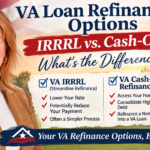
An Interest Rate Reduction Refinance Loan (IRRRL), often called a VA streamline refinance, may allow eligible borrowers with an existing VA loan to refinance into different loan terms, potentially reducing their interest rate or making their payment more stable.
A VA cash-out refinance may allow eligible homeowners to refinance an existing VA or non-VA mortgage and, when permitted, access available home equity.
Neither option is automatically the right choice for everyone.
We’ll want to look at the new loan terms, costs, potential savings, and your long-term goals before deciding whether refinancing makes financial sense.
Ready to Explore Your VA Home Loan Benefits?
Here’s what I want you to remember:
You don’t have to become a VA mortgage expert before you call me.
That’s my job!
Whether you’re buying your first home, using your benefits again, considering a refinance, or simply trying to figure out what you’re eligible for, I’m happy to help you understand your options.
Or call or text me at 918-316-7237.
Explore More VA Home Loan Resources
Want to keep learning? Visit my VA Home Loan Resource Center for information about eligibility, financing requirements, the buying process, and additional educational resources.
Lisa Pinnick | Senior Mortgage Loan Officer | All Western Mortgage | NMLS #1810532
All mortgage financing is subject to VA eligibility, credit approval, property requirements, and applicable lender guidelines. VA home loans are guaranteed by the U.S. Department of Veterans Affairs; All Western Mortgage is not a government agency.
Editor’s Note: Originally published November 3, 2025. Updated October 27, 2026, to reflect current VA home loan guidance, clarify common misconceptions, and provide additional educational resources. Program guidelines and lender requirements are subject to change.