Already own a home and wondering whether refinancing your mortgage might be a smart move?
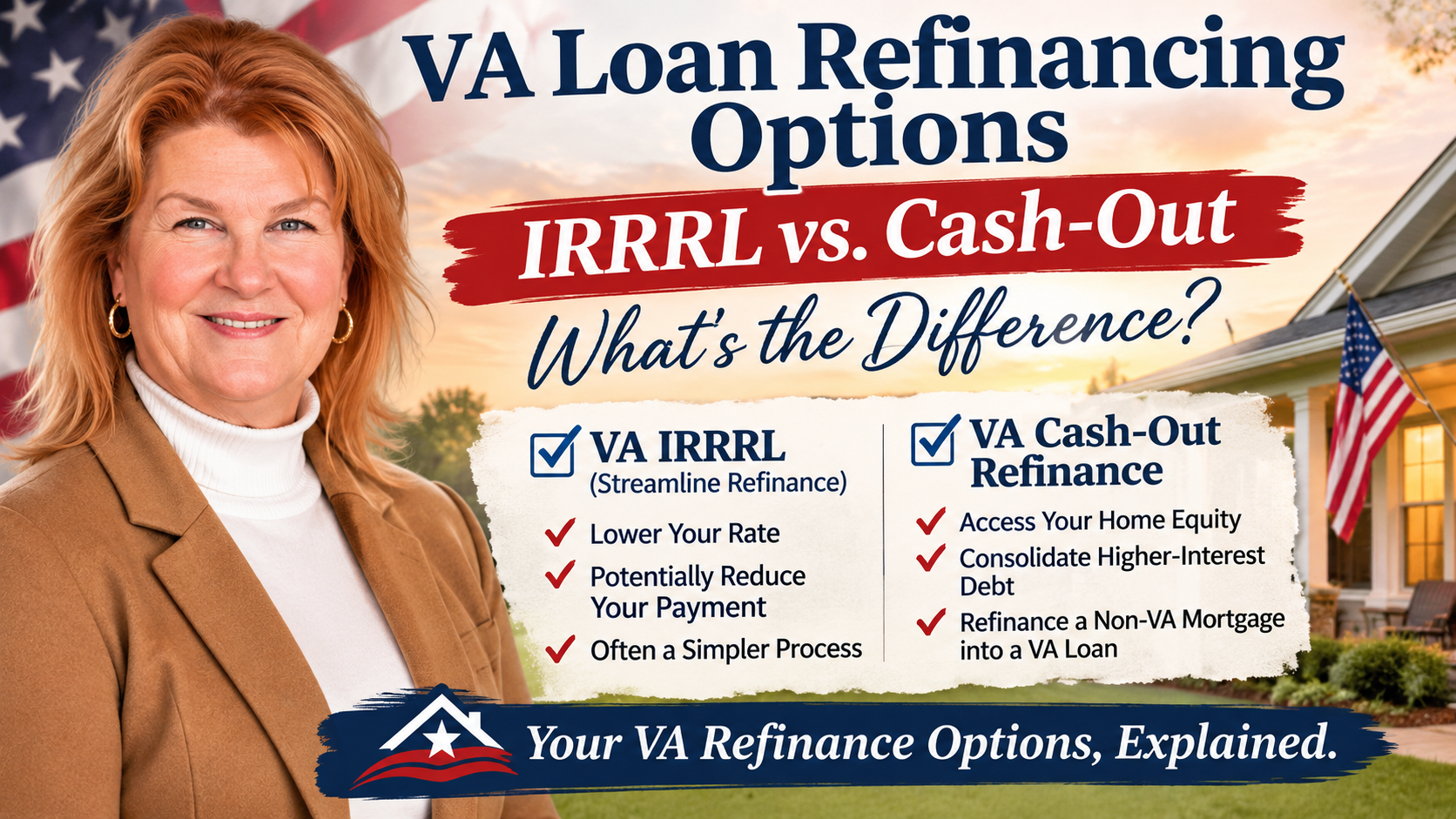
VA Loan Refinancing Options: IRRRL vs. Cash-Out — What’s the Difference?
Already own a home and wondering whether refinancing your mortgage might be a smart move?
If you’re eligible for VA home loan benefits, you may have some options worth exploring!
And no, refinancing doesn’t always mean pulling equity out of your house to remodel the kitchen. Although, depending on the condition of your kitchen, I certainly understand the temptation! 😂
VA home loans aren’t just for purchasing a house. They can also provide refinancing opportunities for eligible homeowners who want to lower their interest rate, change their loan terms, access available home equity, or potentially refinance an existing conventional or FHA mortgage into a VA loan.
But here’s the important part:
Not all VA refinances work the same way.
There are two main options we’ll discuss:
- The VA Interest Rate Reduction Refinance Loan (IRRRL), often called a VA Streamline Refinance.
- The VA Cash-Out Refinance, which can be used for several purposes, including refinancing certain non-VA mortgages.
Let’s look at how each works, who might benefit, and what you should consider before making a decision.
<VIDEO COMING SOON>
What Is a VA IRRRL (Streamline Refinance)?
First, let’s tackle that mouthful of mortgage terminology!
IRRRL stands for Interest Rate Reduction Refinance Loan.
Try saying that three times fast!
Fortunately, it’s much easier to understand than it is to pronounce.
A VA IRRRL is a refinancing option designed specifically for homeowners who already have a VA-backed mortgage on the property.
Its primary purpose is to help eligible borrowers obtain a lower interest rate and potentially reduce their monthly mortgage payment, or move from an adjustable-rate mortgage to a more stable fixed-rate loan.
Because it’s designed to refinance an existing VA loan, the process is often simpler than a traditional refinance.
That’s why you’ll frequently hear it called a VA Streamline Refinance.
What Are the Benefits of a VA IRRRL?
Depending on your situation, an IRRRL may offer several advantages.
1. A potentially lower interest rate
If market interest rates have dropped since you obtained your original VA mortgage, refinancing may help lower your rate.
And a lower rate could mean a lower monthly principal and interest payment.
2. A more predictable mortgage payment
If you currently have a VA adjustable-rate mortgage (ARM), an IRRRL may allow you to move into a fixed-rate loan.
Your interest rate could potentially increase in that situation, but the stability of a fixed rate may still be worth considering.
3. A streamlined process
VA IRRRLs generally don’t require a new appraisal or the same level of credit and income underwriting required for a typical purchase or cash-out refinance.
That doesn’t mean there are no lender requirements!
Your lender still has to verify that the transaction meets applicable VA guidelines and any additional investor requirements.
4. Potentially fewer upfront expenses
Certain allowable closing costs and the VA funding fee may be included in the new loan, subject to program requirements.
This can sometimes reduce the cash you need at closing.
But remember: Financing costs doesn’t make them disappear. You’re adding those expenses to the amount you owe.
Can You Take Cash Out With a VA IRRRL?
No.
A VA IRRRL is not designed to let you withdraw money from your home’s equity.
Its purpose is to refinance your existing VA mortgage under qualifying terms.
If you need to access equity for home improvements, debt consolidation, or another financial goal, we’d need to explore a different option.
And that brings us to the VA Cash-Out Refinance!
What Is a VA Cash-Out Refinance?
Despite its name, a VA Cash-Out Refinance isn’t always about walking away from closing with a check.
This type of VA refinance can be used to replace an existing mortgage with a new VA-backed loan.
Depending on your circumstances and qualifications, you may be able to:
- Access a portion of your available home equity.
- Consolidate certain debts.
- Pay for home improvements or other expenses.
- Replace an existing non-VA mortgage with VA financing.
That last one surprises a lot of people!
You Don’t Have to Already Have a VA Loan!
Let’s say you purchased your home several years ago using a conventional mortgage.
Maybe you weren’t eligible for VA financing at the time, or perhaps you simply didn’t realize you had the benefit available.
Now you’re interested in refinancing into a VA mortgage.
You may be able to do that!
A VA Cash-Out Refinance can potentially be used to refinance a conventional, FHA, or other qualifying mortgage into a VA-backed loan—even if you aren’t actually receiving cash at closing.
Of course, you’ll still need to meet VA eligibility requirements, credit and income guidelines, property requirements, and applicable lender standards.
But it’s an option worth knowing about.
How Could You Use the Equity in Your Home?
Let’s talk about equity for a minute.
Home equity is the difference between what your home is worth and what you owe on it.
For example, imagine your home is currently worth $300,000 and you owe $200,000 on your existing mortgage.
That means you have approximately $100,000 in equity.
But that doesn’t automatically mean you can—or should—borrow the entire $100,000.
The amount you may be eligible to access depends on several factors, including your property’s appraised value, existing mortgage balance, VA requirements, lender limits, your entitlement, and your ability to qualify.
What Might Someone Use Cash-Out Funds For?
Some homeowners consider a cash-out refinance for things such as:
Home Improvements
Maybe you need a new roof, major repairs, or updates that make your home more functional.
Using available equity for improvements may be worth considering, especially if those improvements help maintain or improve your property’s condition.
But just like any other financing decision, we want to evaluate the costs and benefits before moving forward.
Debt Consolidation
If you’re carrying high-interest debt, such as credit cards or personal loans, using some of your home’s equity to consolidate those balances into a lower-interest mortgage may be worth exploring.
And here’s why.
Let’s say you’re making several monthly payments on high-interest debt. By consolidating those balances into your mortgage, you may be able to reduce your overall monthly payments and free up some breathing room in your budget.
That monthly savings can make a meaningful difference in your financial picture!
Now, there are some important considerations.
When you consolidate unsecured debt into your mortgage, that debt becomes secured by your home. And depending on the new loan term, you could pay more interest over time, even with a lower interest rate.
But that doesn’t automatically mean debt consolidation is a bad financial decision.
If the new financing reduces your interest expense, improves your monthly cash flow, or gives you the opportunity to pay down debt more effectively, those benefits may make the strategy worthwhile.
That’s why we need to run the numbers instead of making assumptions.
We’ll compare what you’re paying now, what the new payment would look like, how much the refinance costs, and how the change could affect your finances over time.
We’ll also consider the risks of securing that debt with your home and what happens if you extend the repayment period.
Sometimes consolidating debt makes excellent financial sense. Sometimes it doesn’t.
My job is to help you understand the difference so you can make an informed decision.
Education or Other Significant Expenses
Some homeowners consider accessing equity to help cover education expenses or other major financial needs.
Depending on your circumstances, this may be worth exploring alongside other financing options.
Financial Planning
Sometimes homeowners want to explore whether accessing equity fits a larger financial strategy.
But I want to be very clear about something:
Just because you have equity doesn’t mean you should automatically borrow against it.
Your home is one of your most important assets, and refinancing should make sense for your overall financial picture.
VA IRRRL vs. VA Cash-Out: What’s the Difference?
Here’s a side-by-side look at the two refinancing options.
| Feature | VA IRRRL | VA Cash-Out Refinance |
|---|---|---|
| Must already have a VA mortgage on the property? | Yes | No |
| Can refinance an existing non-VA mortgage? | No | Yes |
| Can receive cash from home equity? | No | Potentially |
| Appraisal required? | Generally no | Generally yes |
| Credit and income review? | Often streamlined | Generally required |
| Occupancy requirement | Current or previous occupancy certification | Generally must occupy as primary residence |
| Closing costs? | Yes, potentially financed | Yes, financing depends on available loan capacity |
| VA funding fee? | Generally 0.5%, unless exempt | Generally based on first or subsequent use, unless exempt |
Both options are subject to VA requirements and lender approval.
Do You Have to Live in the Home to Refinance With a VA Loan?
This is another important difference between the two programs.
VA IRRRL Occupancy
With an IRRRL, you generally need to certify that you currently occupy or previously occupied the home as your primary residence.
That means an IRRRL may be possible even if you’ve since moved out of the property, provided you meet the other requirements.
For example, a veteran who originally occupied a home purchased with VA financing and later relocated may still qualify for an IRRRL.
VA Cash-Out Refinance Occupancy
A VA Cash-Out Refinance generally requires that the borrower occupy the property as their primary residence under applicable VA occupancy requirements.
It’s not intended as a financing program for a property held solely as an investment.
That difference matters if you’ve relocated or converted a previous home into a rental.
And it’s one more reason I like to review the entire situation before recommending a program.
What About VA Refinancing Closing Costs and Funding Fees?
Refinancing involves costs, just like purchasing a home.
Depending on the loan, those expenses may include lender fees, title-related charges, discount points, appraisal costs, prepaid expenses, and the VA funding fee.
VA IRRRL Funding Fee
For borrowers who aren’t exempt, the VA funding fee for an IRRRL is generally 0.5% of the loan amount.
VA Cash-Out Funding Fee
For borrowers who aren’t exempt, the VA funding fee for cash-out refinancing is generally:
- 2.15% for first use of the VA home loan benefit.
- 3.3% for subsequent use.
Some eligible veterans and other qualifying borrowers are exempt from the funding fee, including certain borrowers receiving VA disability compensation.
The funding fee is not the only expense involved in refinancing, so it’s important to evaluate your complete Loan Estimate.
For more information, explore my guide to VA Loan Closing Costs & Funding Fees: What Buyers Need to Know, available through the VA Home Loan Resource Center.
When Does Refinancing Actually Make Sense?
Now we’re getting to one of my favorite questions.
Not “Can you refinance?”
But “Should you refinance?”
Those are two very different things!
Look Beyond the Interest Rate
Let’s say your new loan would reduce your monthly principal and interest payment by $150.
Sounds good, right?
But what if refinancing costs you $4,500?
If we use a simple break-even calculation:
$4,500 ÷ $150 = 30 months.
That means it would take approximately 30 months of savings to recover those upfront costs.
And that’s only a simplified illustration.
We’d also want to consider whether you’re financing closing costs, changing the remaining loan term, or affecting your total interest expenses.
Be Careful About Restarting Your Mortgage Term
Imagine you’re 10 years into a 30-year mortgage.
You currently have about 20 years remaining.
If you refinance into a new 30-year loan, you’re extending your repayment schedule.
Even if the new monthly payment is lower, you could end up paying more interest over time.
That doesn’t automatically mean refinancing is a bad idea.
But it’s something we absolutely need to consider when comparing your options.
What If You Already Have a Great Interest Rate?
I know this one comes up quite a bit!
Maybe you purchased or refinanced when interest rates were exceptionally low.
And now you’re thinking about tapping into your equity.
Before replacing that low-rate mortgage with a new loan, I’d want to compare the costs and benefits carefully.
There may be other financing options worth evaluating, depending on your credit, equity, and financial goals.
The objective isn’t simply to complete a refinance.
It’s to help you make a financial decision that makes sense.
Can You Refinance a VA Loan Anytime You Want?
Not necessarily.
VA refinancing programs have specific requirements, and some transactions must meet minimum loan-seasoning rules.
For example, certain VA-to-VA refinances generally require at least six consecutive monthly payments and a minimum of 210 days after the first payment due date before the refinance can close.
There are also rules designed to help ensure that refinancing provides a genuine financial benefit to the borrower.
These requirements may include interest-rate reduction standards, fee recoupment, and what’s known as a net tangible benefit.
Different requirements can apply depending on the refinance type and the circumstances.
So even if rates drop shortly after you purchase your home, you may not immediately qualify to refinance.
We’ll review the applicable requirements before making plans.
How Do You Know Which VA Refinance Is Right for You?
Here’s the simplest way I can explain it.
If you already have a VA loan and your goal is to lower your interest rate or move from an adjustable rate to a fixed rate:
A VA IRRRL may be worth exploring.
If you want to access available equity or refinance a non-VA mortgage into a VA mortgage:
A VA Cash-Out Refinance may be an option.
If you’re not sure whether either one makes financial sense:
That’s where I come in!
We’ll compare your current mortgage with the available options and look at the numbers—not just the advertised interest rate.
We’ll consider your payment, closing costs, remaining loan term, total interest, equity, and long-term plans.
And if staying with your existing mortgage is the better option?
I’ll tell you that, too.
Let’s Explore Your VA Refinancing Options
If you’re a veteran or another eligible borrower wondering whether refinancing could help you reach your financial goals, I’d love to help you explore the possibilities.
Whether your goal is a lower payment, more predictable financing, accessing equity, or converting an existing mortgage into VA financing, we’ll start by understanding your situation.
Then we’ll look at what’s available and whether it makes sense for you.
Or call or text me at 918-316-7237.
I’m Lisa with the Mortgage Dream Team, and finding solutions that fit your goals is what I do!
More VA Home Loan Resources
If you’d like to learn more about your VA benefits, visit my VA Home Loan Resource Center.
You may also find these articles helpful:
- VA Loan Closing Costs & Funding Fees: What Buyers Need to Know
Understand funding fees, exemptions, and expenses associated with VA financing. - Can You Use Your VA Home Loan Benefit More Than Once?
Learn about entitlement restoration and using your VA benefit again. - VA Home Loan FAQs: Your Questions Answered
Answers to common questions about VA financing.
For official program information, you can also review the Department of Veterans Affairs’ guides to VA IRRRLs and VA Cash-Out Refinancing.
Lisa Pinnick | Senior Mortgage Loan Officer | All Western Mortgage | NMLS #1810532
All loans are subject to credit approval, VA eligibility, property requirements, applicable investor guidelines, and underwriting approval. Refinancing may result in new loan terms, fees, higher total interest costs, or an extended repayment period. Cash-out refinancing uses home equity and increases the debt secured by the property. Failure to repay a mortgage can result in foreclosure. VA funding fee exemptions and requirements vary by borrower and transaction. All Western Mortgage is not affiliated with or endorsed by the U.S. Department of Veterans Affairs. Additional company and licensing disclosures may apply.
Published November 2026. Program rules and lender requirements are subject to change.